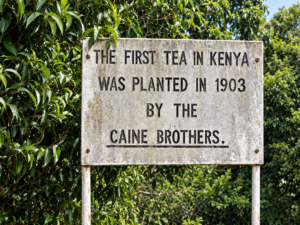
Unlike tea in Kenya, rooibos was not introduced to South Africa from abroad. The plant, Aspalathus linearis, is native to the Cederberg and surrounding regions of the Western Cape. Exactly when people first began using it as a drink is unknown, but indigenous Khoi and San communities held traditional knowledge associated with the plant long before it became a commercial product.
1772
European botanist Carl Peter Thunberg travelled through the Cape and recorded local people preparing a tea-like drink from an Aspalathus plant. The account is often linked to the early history of rooibos, although later botanical research has questioned whether the plant he described was Aspalathus linearis itself.
1904
A clearer turning point came when Benjamin Ginsberg a Russian immigrant began trading the locally produced “mountain tea,” helping transform rooibos from a regional drink into a commercial product. At the time, however, the seeds were tiny, difficult to find and protected by a hard outer shell that made germination unpredictable.
1930s
Commercial cultivation began to become practical through the work of Dr Pieter Le Fras Nortier, a doctor and nature enthusiast based in Clanwilliam. Nortier experimented with the propagation of rooibos together with local farmers including Oloff Bergh and William Riordan, with encouragement from Benjamin Ginsberg. Early experiments took place on farms near Clanwilliam. Finding sufficient seed remained a major obstacle.
Local residents played an important role in solving this problem. Historical accounts describe Hans and Tryntjie Swart, who discovered that ants collected rooibos seeds and stored them underground. By opening ant nests, they were able to collect quantities of seed that would otherwise have been extremely difficult to find in the sandy soil. Nortier also found that the hard seed coat needed to be broken or scarified before planting in order to improve germination. These developments helped turn rooibos from a largely wild-harvested regional plant into a crop that farmers could cultivate more consistently. Commercial production expanded during the following decades.
1948
After the Second World War, the rooibos industry experienced difficult market conditions, including shortages of good-quality seed and inconsistent product quality. Producers established the Clanwilliam Tea Cooperative in an effort to stabilise production and marketing.
1954
Farmers subsequently requested greater regulation of the industry, leading to the establishment of the Rooibos Tea Control Board. Its role included regulating marketing, improving quality standards and helping stabilise prices within the developing industry.
While large commercial farms became increasingly prominent, smaller-scale producers and communities continued to play a role in both cultivated and wild rooibos production. In areas such as Wupperthal and the Suid Bokkeveld, rooibos remains connected with smallholder farming and local ecological knowledge. Some producers continue to harvest wild rooibos alongside cultivated crops.
1968
Rooibos gained wider attention within South Africa after Annetjie Theron, a South African mother, began publicly describing her experience using rooibos with her infant. Her claims helped generate greater public interest in the plant and later contributed to the development of rooibos-based consumer products.
1993
South Africa’s rooibos industry entered another phase when the Rooibos Tea Control Board was transformed into the privately owned company Rooibos Limited.
By this period, rooibos was no longer simply a regional South African drink. Exports were expanding and rooibos had begun to appear in international supermarkets, speciality tea shops and health-food stores.
1990s–2000s
Another development was the growth of green rooibos. Traditional red rooibos develops its familiar reddish-brown colour when the harvested plant material is cut, bruised and allowed to oxidise before drying. Green rooibos is processed in a way that limits oxidation, allowing the leaves to retain more of their green colour and producing a lighter flavour profile.
2015
The history of rooibos raised an important question: Who should benefit from the knowledge that made the commercial industry possible?
After concerns were raised by representatives of the San community, the South African government carried out research into the historical knowledge associated with rooibos and honeybush. The study concluded that there was no evidence to dispute the claims of the Khoi and San peoples as holders of the traditional knowledge associated with these plants.
This finding became the basis for negotiations between indigenous communities and the commercial rooibos industry.
2019
Those negotiations resulted in the signing of the Rooibos Traditional Knowledge Industry-Wide Benefit Sharing Agreement. Under the agreement, the rooibos industry agreed to make payments linked to the farm-gate value of rooibos purchased by processors. The agreement established a levy equivalent to 1.5 per cent of the farm-gate price, with benefits shared between Khoi and San communities through designated trusts.
2021
Rooibos received another form of recognition internationally when the European Union registered “Rooibos / Red Bush” as a Protected Designation of Origin, or PDO. The protection means that within the EU, the name Rooibos or Red Bush may be used for the dried leaves and stems of Aspalathus linearis produced within the defined South African geographical area covered by the specification. This places rooibos alongside other products whose identity is legally connected with their place of origin.
2024
By 2024, approximately 9.76 million kilograms of rooibos were exported from South Africa.
Japan was the largest destination, receiving approximately 2.91 million kilograms, or 30 per cent of exports. Germany followed with approximately 1.63 million kilograms, while the Netherlands, United Kingdom, France, United States, China and several African countries were also important markets.
2025
Rooibos exports passed 10,000 tonnes for the first time, reaching approximately 10,930 tonnes.
In South Africa, rooibos is also an everyday drink. It can be served simply with hot water, but many people drink it in much the same way as conventional tea, with milk, sugar, lemon or honey according to preference. It is also served cold, used in iced drinks and increasingly appears in cafés as rooibos lattes and other modern preparations.
Because rooibos is naturally caffeine-free, it is also commonly enjoyed later in the day and is found in many South African households.
Today, someone may encounter rooibos in a café in Vienna, a supermarket in Tokyo or a speciality tea shop in London. But behind that cup is the dry fynbos landscape of South Africa, generations of knowledge about the plant, farmers and harvesters who work with it, and communities whose connection with rooibos reaches back long before it became an international product.