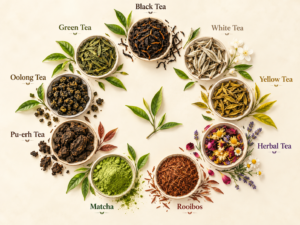
Tea may begin with the same plant, Camellia sinensis, but it can take remarkably different forms depending on where it is grown and how its leaves are processed.
China is known for its range of tea-making techniques. India has established regional styles with recognisable flavour profiles. Across Africa, tea producers cultivate black, green, white and speciality teas, while the continent is also home to herbal infusions such as rooibos.
Understanding these differences begins with the conditions in which tea grows.
Tea cultivation takes place at widely varying elevations. Some established growing regions lie close to sea level, while others are situated in mountain landscapes.
| Origin | Documented growing elevations |
|---|---|
| China — selected Pu-erh tea gardens in Yunnan | 1,614–1,901 m |
| India — Assam | 45–60 m |
| India — Darjeeling | 600–2,000 m |
| Africa — Kenya’s principal tea-growing areas | 1,500–2,700 m |
| Africa — Rwanda’s tea-growing areas | 1,550–2,500 m |
China
One of China’s main strengths lies in the diversity of its tea-making techniques.
Chinese producers have developed six broad categories: green, yellow, white, oolong, black and dark tea. Their traditional processing techniques and associated social practices were inscribed on UNESCO’s Representative List of the Intangible Cultural Heritage of Humanity in 2022.
Processing has an important influence on the finished tea. Green tea is typically heated early to limit enzymatic oxidation, helping preserve its characteristic green appearance and chemical profile. Oolong undergoes partial oxidation, while black tea undergoes more extensive oxidation. Dark teas, including certain Pu-erh styles, involve microbial processes.
These techniques produce differences in aroma, colour, flavour and chemical composition.
India
India illustrates how different growing environments within one country can produce contrasting tea styles.
Assam, situated in northeastern India, is known particularly for black teas with a strong, full-bodied and often malty character. Both orthodox and crush-tear-curl (CTC) teas are manufactured in the region.
Darjeeling, by comparison, produces teas in the Himalayan foothills. Its black teas are often appreciated for their aromatic character, which can vary with the harvest season and processing method.
Africa
Africa’s tea industry includes several distinct producing regions rather than one uniform style.
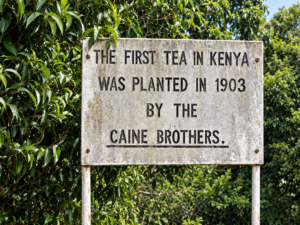
Kenya has a well-established black tea industry, with CTC tea playing an important role. Rwanda also produces predominantly CTC black tea, alongside smaller quantities of orthodox, green and white teas.
Speciality production is another part of Africa’s tea landscape.
Kenyan researchers have investigated purple-leaf tea varieties, which contain anthocyanin pigments. In a 2013 study published in Food Chemistry, 12 Kenyan purple-leaf tea accessions were compared with two reference varieties from China and Japan. The Kenyan samples had higher total polyphenol content than those particular reference varieties.
Mozambique also produces speciality white tea. Industry reporting has documented white tea production at the Monte Metilile estate, showing that this style of processing is practised beyond its historical Asian origins.
South African rooibos, made from Aspalathus linearis, is a naturally caffeine-free herbal infusion. It has a different botanical origin and chemical composition from conventional tea.
A 2024 systematic review examined eight human studies involving 175 participants and concluded that evidence for rooibos-related health benefits remains insufficient. Rooibos can nevertheless be appreciated for its botanical identity, flavour and absence of caffeine.
Discover African tea with Sippa Shop
References and Further Reading
1. UNESCO (2022). Traditional tea processing techniques and associated social practices in China.
2. Wong, M., Sirisena, S., & Ng, K. (2022). Phytochemical profile of differently processed tea: A review. Journal of Food Science.
https://doi.org/10.1111/1750-3841.16137
3. Tea Board India. Official information on Assam and Darjeeling growing regions and tea characteristics.
4. Chen, M.-M., et al. (2024). Effects of Geographical Origin and Tree Age on the Stable Isotopes and Multi-Elements of Pu-erh Tea. Foods, 13(3), 473.
https://doi.org/10.3390/foods13030473
5. Kilel, E. C., et al. (2013). Green tea from purple leaf coloured tea clones in Kenya—their quality characteristics. Food Chemistry, 141(2), 769–775.
https://doi.org/10.1016/j.foodchem.2013.03.051
6. Rugema, G., et al. (2025). Phytochemical Composition of Selected Tea Clones Grown in Two Agroecology Regions of Rwanda. European Journal of Agriculture and Food Sciences.
https://doi.org/10.24018/ejfood.2025.7.5.960
7. Koch, W., Kukula-Koch, W., & Komsta, Ł. (2018). Black tea samples origin discrimination using analytical investigations of secondary metabolites, antiradical scavenging activity and chemometric approach. Molecules, 23(3), 513.
https://doi.org/10.3390/molecules23030513
8. Speer, K. E., et al. (2024). The Effect of Rooibos Tea (Aspalathus linearis) Consumption on Human Health Outcomes: A Systematic Literature Review. Beverages, 10(4), 113.
https://doi.org/10.3390/beverages10040113
Additional sources: Kenya’s tea-growing altitude: https://doi.org/10.3390/agronomy14092080; Rwanda Development Board: https://rdb.rw/export/; Mozambique white tea production (industry reporting): https://teajourney.pub/magnificant-mozambique/.